Jazz Theory: Body and Soul
Harmonic analysis of the jazz standard "Body and Soul" by Johnny Green.
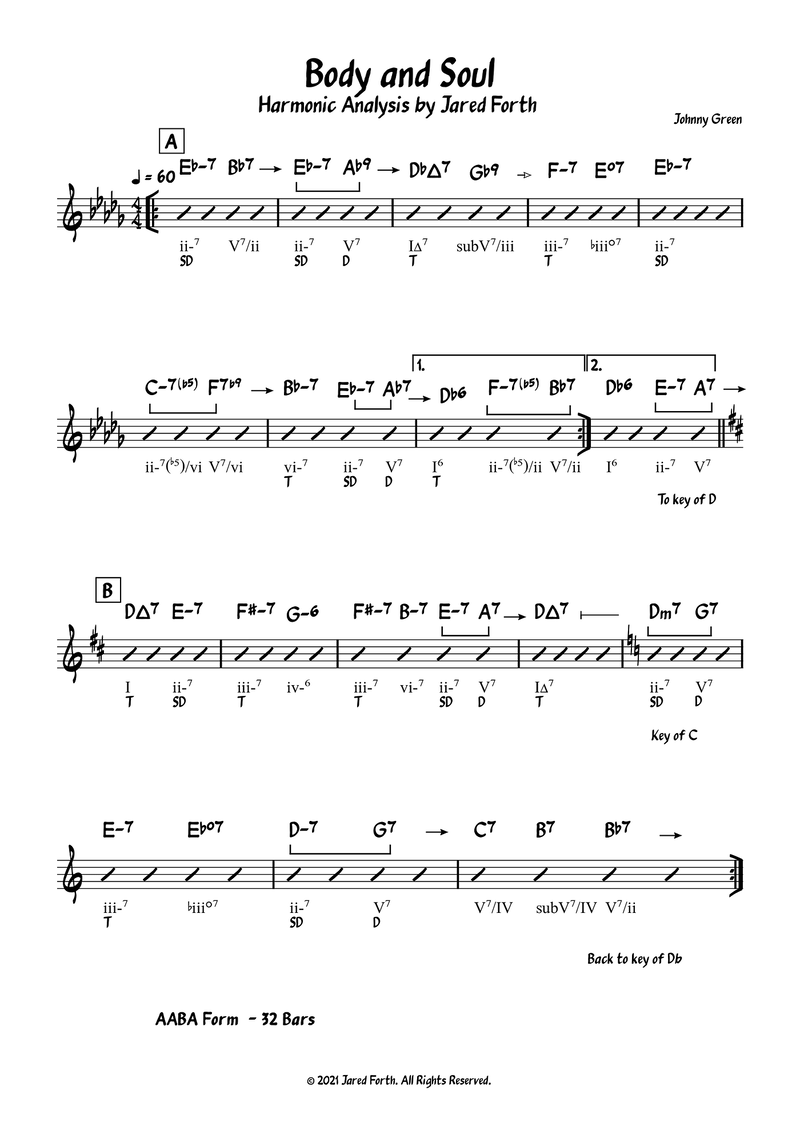
Body and Soul was composed by Johnny Green in 1930. The original key is Db and the song follows a 32-bar AABA form. This is a jazz harmonic analysis of the changes in Body and Soul, along with an explanation of the concepts used in the analysis. The image above shows my full analysis, which I will walk through below. You can refer to the conventions page for a deeper exploration of the analytic concepts used and get the PDF for free.
Section A
At the beginning of section A is a ii-7, V7/ii-7, ii-7 cadence. The V7/ii-7 is a secondary dominant that briefly tonicizes the ii but the piece does not modulate. Measure 2 has a subdominant, dominant, tonic cadence expressed as a ii-7, V7, IΔ7 which is followed by the Gb9 chord on beat 3 of measure 3.
I chose to mark the Gb9 as a tritone substitution of the secondary dominant V7/iii, but it could be thought of as a chord borrowed from a modal exchange because it is the IV, just a dominant 7 instead of a Δ7. We could think of this as coming from Db Dorian or Db Melodic Minor because both of these scales create a IV chord with a b7. We could also think of this as just a passing chord leading chromatically to the diatonic iii-7, which is F-7 in this case. We use our outline arrow here to represent a V7 resolving down a half step.
The iii-7, F-7, is followed by a passing diminished chord (biiio7) to lead to the subdominant ii-7. Measure 6 begins with a ii-7(b5), V7 secondary dominant with a related ii-7 cadence going to the vi-7. We then have a ii, V, I followed by a ii, V secondary dominant leading back to the ii-7.
The second ending for the second time through the A section has a ii-7, V7 modulating to the key of D for the B section.
Section B
This section begins with a diatonic IΔ7, ii-7, iii-7 progression in the new key of D. The next G-6 chord is a iv-, so it is not in the key. This can be thought of as a modal interchange chord borrowing from the Aeolian mode. The next measure is just a diatonic iii, vi, ii, V turnaround leading back to the tonic. Here we have the new "to minor" symbol where the DΔ7 leads to the D-7. The piece also modulates to C here, and the D-7 is the first of a ii-7, V7 in C. Instead of resolving to a C, the weeker tonic sound of iii-7 is used. We then have a passing biii diminished chord leading to another ii-7, V7. The V7 here does not resolve to the tonic, but rather to a I7. This could be thought of as a modal interchange chord from C Mixolydian but I marked it as the secondary dominant V7/IV. The next chord could be thought of as a passing chord or as a tritone substitution of the V7/IV. The final Bb7 is the V7/ii-7 in the key of Db, which leads us back to section A.